
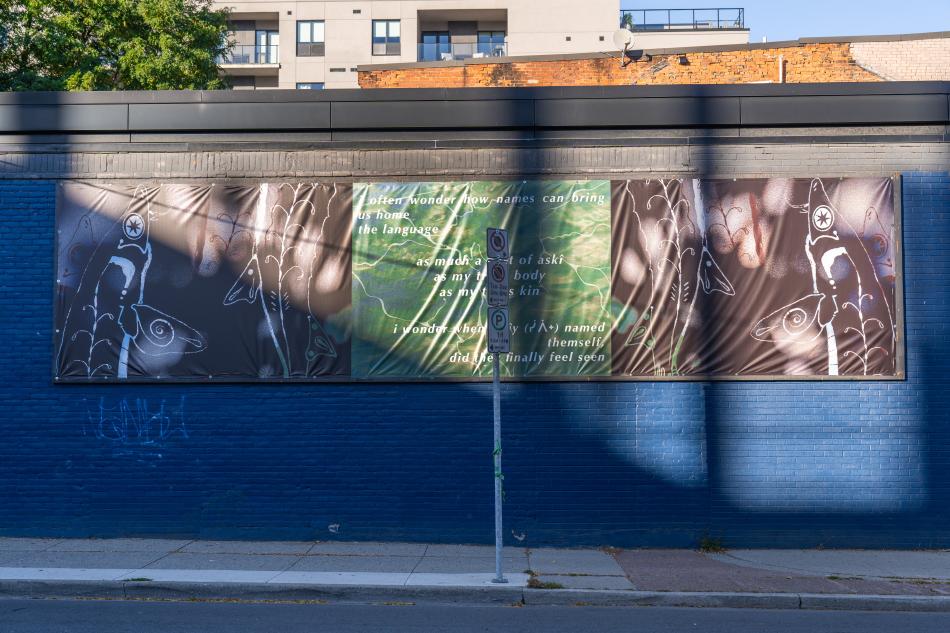
I wonder when sîpîy (ᓰᐲᕀ) named themself, did they finally feel seen
Theo Donovan
- / Cannon Project Wall
I wonder when sîpîy (ᓰᐲᕀ) named themself, did they finally feel seen (2026) is a mixed media photographic collage billboard that uses a combination of physical drawing, digital manipulation and photography to tell the story of queer connections to the land. A fractal pattern dances across the surface of the water, connecting the illustrations of river sturgeon on either side. At the center is text which reads:
I often wonder how names can bring us home
the language
as much a part of askî
as my trans body
as my trans kin
I wonder when sîpîy (ᓰᐲᕀ) named themself,
did they finally feel seen
Fractal patterns are found in waterways, rock formations, trees, leaves, as well as in our nervous systems, lungs, and veins. This visual parallel reminds us that we are all interconnected, the walking, the flying, the growing, the flowing. I use fractal patterns in my work to visually express these connections through mapping or tracing. In my practice I use walking as a research methodology and praxis. I visit the land, visit kin, and trace/sketch the patterns I come across to then incorporate them into my work.
At the core of this body of work is a community gathering that will stick with me for a lifetime, and for which I am so grateful (maarsii for this story). At a truth and reconciliation gathering at Métis Crossing in 2023, an Elder told us something about the Cree language that I will never forget. He told us stories of his relationship to language and the land and said that Cree is special because “the earth named herself, we simply listened.” The example he shared is of the word for river in Cree and Michif, ᓰᐲᕀ sîpîy. He encouraged us to sit by the river and hear her speak, echoing her name. “The earth named herself”, just as my transgender kin and I have. What a blessing it is to be known and held by them and nîpî. Trans kin are sacred! And water is life.
Indigenous languages are a part of this land as much as I am, as much as our non-human relatives are. Working towards strengthening our connection to the land, each other, and languages will be a lifelong process of learning and listening. And in an age of the climate crisis, ongoing genocides, police violence and more grief than we can hold, returning to the land, to each other and to language is vital resistance.
I often wonder what transience teaches us
like fractals
cracking the sidewalk ahead
an act of revealing time
tearing through layers of history
of grief
no end point
endlessly iterative
connecting small parts of a whole
I often wonder how names can bring us home
the language
as much a part of askî
as my trans body
as my trans kin
I wonder when sîpîy (ᓰᐲᕀ) named themself,
did they finally feel seen
I often wonder how to map something I can’t grasp
this joy
fracturing and spiralling inwards
touching everything on its way in
this map is burning hot
with friction
rife with Imperfections
(held)
hand after
hand after hand
after
tracing our stories
Theo Donovan (he/they) is a queer mixed ancestry Red River Métis/Michif artist who gratefully resides in ᐊᒥᐢᑿᒌᐚᐢᑲᐦᐃᑲᐣ (Amiskwacîwâskahikan), Treaty 6 Territory, St. Albert Métis District. Theo is an interdisciplinary visual artist, writer, teacher and activist who holds a Bachelor of Studio Arts with Distinction from MacEwan University. At the core of his practice are notions of curiosity and play, tender care and slowness, queer joy and resistance. He is guided by an understanding that knowledge is interconnected; we have as much to learn from the land, from craft, from oral traditions and song as we do novels and lectures. Theo’s current body of research explores slow relational practices, such as walking and beading, as acts of survivance. Theo’s creative practice works towards strengthening his connection to land, to kin, and to language.
 ©2026 Hamilton Artists Inc.